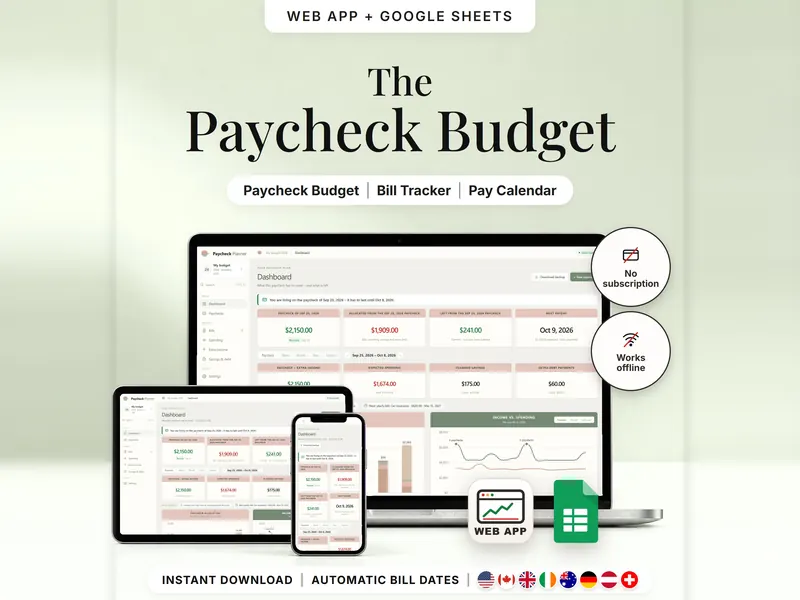
Paycheck Budget Planner
Plan bills, spending and savings by payday and see what's left until the next one.
- Web app + Sheets
€6.99*

Free calculator
Choose how often you're paid, enter one payday you know and pick a year. You'll see which months have three paychecks – or five, if you're paid weekly – and every payday of that year.
An organizing tool – not financial, tax or legal advice.
Paydays on a biweekly schedule are exactly 14 days apart; weekly paydays are 7 days apart. Starting from the date you enter, the calculator counts forward and back through the year you picked and lists every payday that falls inside it. A month with three biweekly paydays – or five weekly ones – is marked.
That's why one date is enough, and why the weekday alone isn't: two people paid every other Friday can have their third paycheck in different months, because their Fridays alternate. Any payday works, past or upcoming, even one from another year.
The calculator keeps every payday on its calendar date. When a payday falls on a Federal Reserve holiday, it says so and shows where the paycheck would land if your employer pays a business day early or late – for example Friday, Jan 1, 2027 (New Year's Day), which some employers pay on Thursday, Dec 31, 2026. Your pay stub, your employer's payroll calendar or HR can tell you which way yours goes.
The guide Three-paycheck months in 2027 has the months for every weekday in tables for 2026, 2027 and 2028, explains why some years have 27 paydays and lists neutral options for planning a third paycheck.
To plan those months in a budget by paycheck, our Paycheck Budget Planner flags extra-paycheck months for up to 4 incomes – as an offline web app plus a separate Google Sheets™ version. The two don't sync.
Plan bills, spending and savings by payday and see what's left until the next one.