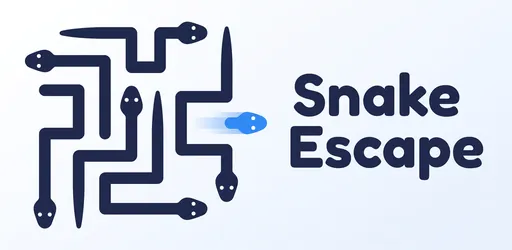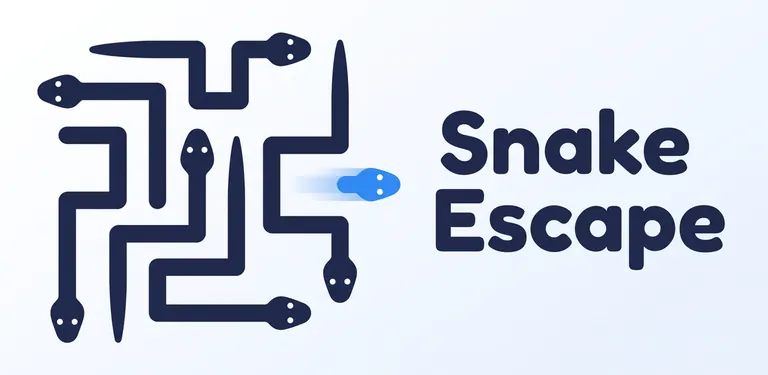
Arrow puzzles are logic puzzles with very few rules. A board is full of pieces – arrows, blocks or, in our game Snake Escape, snakes – and each piece can only leave the board in one direction. Tap a piece, and it moves until it either leaves the board or runs into something. Your job is to clear the board without crashing.
We make one of these games ourselves, so this guide uses the rules of Snake Escape as the example. The method works the same way for most arrow and tap-away puzzles.
How arrow puzzles work
Before you plan a single move, it helps to know exactly what the game checks:
- Direction comes from the head. A snake moves the way its head points, just like an arrow. The shape of its body does not matter for the direction.
- The body follows the head. When a snake moves, its body slides along the path of its head. So the only line that has to be free is the line in front of the head, all the way to the edge.
- Only the outer edge is an exit. Many boards have the shape of a heart, a star or another figure. Holes inside the figure are empty, but they are not a way out – a snake has to reach the outer edge.
- A crash costs a life. If another snake is in the way, your snake bumps into it and bounces back. In Snake Escape that costs one of three lives, and the board stays exactly as it was.
Step by step: how to solve an arrow puzzle
- Scan the edges first. Snakes close to the border have the shortest way out and are often free. Start your search there.
- Follow each head with your eyes. Trace the straight line from the head to the edge. If nothing sits on that line, the snake can go.
- Tap every free snake you find. Each snake that leaves opens space for the ones behind it.
- Scan again. After a few moves the board looks different. Snakes that were blocked a moment ago now have a clear line.
- Work from the outside in. On big boards the centre opens up last. If you are stuck in the middle, go back to the edges – there is usually a free snake you missed.
The key habit is to look at heads, not bodies. Long, curly snakes draw your eye, but whether a snake can leave depends only on the line in front of its head.
Does the order matter?
On a board that has only snakes, walls and locks, a free snake stays free until you tap it. Removing a snake only empties cells and can open a lock – it never closes a path. That means any free snake is a safe move, and you cannot make the level impossible by taking free snakes in the "wrong" order. The puzzle is finding them.
This changes on boards with elements that react to your moves. In later levels of Snake Escape, a snake can work a switch when it leaves, and that switch changes a gate, an arrow or an exit marked with the same dots. On such boards a legal move can lead into a dead end, where no move can still win. Before you tap, ask: does this snake change something else on the board, and do I still need that path later?
Tips for obstacles
- Locks and keys: A locked snake cannot leave until the snake with the matching key has left the board. Find the key snake first and clear its path.
- Walls: Grey stone blocks are walls. No snake can pass them, so they shape where the ways out are. A snake whose head points straight into a wall is blocked by it.
- One-way fields: These fields can only be crossed in the direction of their arrow. A snake whose line crosses a one-way field against the arrow is blocked.
- Switches and gates: Watch the dots. A snake with a switch changes every element with the same dots when it leaves. Think one step ahead before you open or close a gate.
- Closed is not a crash: If an element is visibly closed – a lock, a shut gate – the tap is refused and costs no life. A crash into another snake does cost one.
Common mistakes
- Reading the body instead of the head. The direction is set by the head alone.
- Counting on holes as exits. Gaps inside a figure look free, but they lead nowhere.
- Tapping too fast. In the classic levels there is no timer, so a careful look costs nothing, while a crash costs a life.
- Forgetting the key. When a snake will not move although its line looks free, check whether it is locked.
Tools that help in Snake Escape
The Android app has a few helpers for big boards. You can pinch to zoom and show all paths with one button, which draws each snake's way out on the board. The hint button points to a snake that can move when you are stuck. If you prefer no pressure at all, the app also has a relaxing Zen mode; an optional Time Race mode is there for players who want a clock. New obstacles are explained when you meet them for the first time.
Practise with real levels
The quickest way to try these tips is the free browser demo on the Snake Escape game page: 10 Knot levels from worlds 7 to 10 of the app, with switches and gates, one-way fields, locks and walls. If you get stuck in a dead end there, you can restart from the pause menu without losing a life.
The full game, Snake Escape: Tap Arrow Puzzle, has 5,000 levels in 10 worlds and is free on Google Play. It shows ads, but not after every level, and a one-time purchase removes them. If you want to know why this kind of puzzle is so satisfying, read our guide to brain puzzle games for adults.