Not every game that calls itself a brain game is really a puzzle. A true logic puzzle has a clear set of rules, one board, and a solution you reach by thinking, not by luck or fast reflexes. That is what many adults look for: something that asks for a little attention, gives you a clean "aha" moment, and then lets you put the phone down again.
What makes a good brain puzzle for adults
Good puzzles share a few traits, no matter which type you prefer:
- Simple rules, deep play. You understand the rules within a minute, but later boards still surprise you.
- No timer pressure. You can think at your own pace instead of racing a clock.
- Fair difficulty. Mistakes come from your own reasoning, not from hidden information or random events.
- Short sessions. One board takes a few minutes, so it fits into a commute or a break.
The main types of logic puzzle games
Here is a quick overview of the classics and one newer style.
| Puzzle type | How it works | Feels like |
|---|---|---|
| Sudoku | Fill a 9×9 grid so each row, column and box holds 1–9 once | Careful elimination |
| Nonogram | Number clues tell you which cells to fill until a picture appears | A slow, satisfying reveal |
| Sliding puzzle | Move tiles or blocks until one piece can get out | Planning several moves ahead |
| Tap-away / arrow puzzle | Tap pieces in the right order so each one can leave the board | Untangling a knot |
Sudoku
The number puzzle almost everyone knows. You do not need math, only logic: you rule out what cannot go in a cell until one option remains. It suits people who like quiet, methodical thinking.
Nonograms
Also called picture cross puzzles. Each row and column has number clues, and once you solve them all, a small pixel image appears. Nonograms take longer than a Sudoku and reward patience.
Sliding puzzles
From the classic 15-tile puzzle to block-shuffling boards. The challenge is seeing a few moves ahead, because one wrong slide can block the path you need later.
Tap-away and arrow puzzles
A newer style that works especially well on a phone. Every piece on the board can only move in one direction, usually shown by an arrow. Tap a piece, and it slides off the board if its path is clear. If something is in the way, it bumps into it. Your job is to find the right order. The rules fit into one sentence, yet larger boards turn into real chains of reasoning.
Why short puzzle rounds feel so good
Many players enjoy puzzles in short bursts rather than long sessions. Here is why:
- A clear finish. A cleared board is a small, complete result. You know exactly when you are done.
- Low commitment. You can play one board while the kettle boils and stop without losing anything.
- Visible progress. Level numbers and rising difficulty show how far you have come.
- A calm kind of focus. Unlike action games, nothing rushes you. You look, think, and tap when you are ready.
To be clear: puzzle games are entertainment. They can be a pleasant way to practice spotting patterns and thinking one step ahead, but be wary of any app that promises measurable effects on memory or intelligence.
What to look for in a puzzle app on Android
The differences between puzzle apps often show only after a few days. Before you settle on one, check these points:
- Fair ads. Free games usually show ads, which is fine. What matters is how often. An ad after every single level gets tiring fast, and a one-time option to remove ads is a good sign.
- Hints that help. A good hint shows you the next step without solving the whole board for you.
- A steady difficulty curve. Early levels teach the rules, later levels add new ideas. Sudden jumps make people quit.
- A daily puzzle. One fresh challenge per day gives you a small routine without pressure.
- Storage size. Some games are surprisingly large. If your phone is already full, our guide on freeing up storage on Android shows where space usually hides.
Snake Escape: our own tap-away puzzle
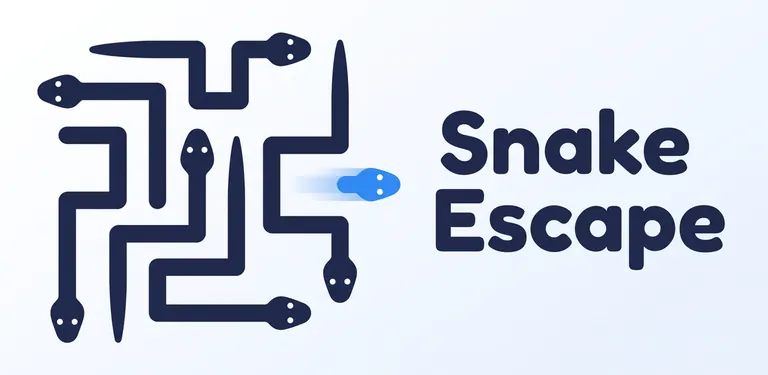
When we started building our own puzzle game, we used exactly this checklist. The result is Snake Escape: Brain Puzzle, a logic puzzle that is now available on Google Play.
The idea is simple. Neon snakes lie on a board, each with arrows that show its direction. Tap a snake, and it glides off the board along its arrows if the way is free. If another snake blocks the path, it bumps into it and you lose one of your three hearts. Clear the whole board to win.
Here is what you can expect:
- 5,000 levels in 10 worlds, with boards in different shapes, such as hearts, stars and trees, with difficulty that rises step by step
- Obstacles like walls, locks and keys that add new ideas along the way
- A hint button for the moments when you are stuck
- A daily puzzle that fills a monthly mosaic as you play
- Ads, but not after every level, plus a purchase to remove them
In our own testing, we noticed that the hearts change how you play. You look twice before you tap, because a careless move costs something. That one small rule turns a simple tap game into a real logic puzzle.
How to get started with logic puzzles
If you are not sure which type suits you, try this:
- Play one board of each type: a Sudoku, a small nonogram, a sliding puzzle and a tap-away puzzle.
- Notice which one you want to play again. That is usually the right genre for you.
- Start with the easy levels, even if they feel too simple. They teach patterns you need later.
- Use hints sparingly. Give yourself a minute or two before you ask for help.
- Keep sessions short. Five minutes a day often feels nicer than one long evening.
If tap-away puzzles sound like your thing, take a look at the Snake Escape game page: it links to the game on Google Play and lets you try 10 of the hardest levels in your browser. You can also browse all stillmeasure. games.
Quick summary
Brain puzzle games for adults come in many forms, from Sudoku and nonograms to sliding puzzles and tap-away arrow puzzles. When you pick an app, look for fair ads, helpful hints, a steady difficulty curve and a daily puzzle. Then enjoy puzzles for what they are: a calm, satisfying break in your day.