Decibels are easy to quote and hard to picture. A number like 85 dB only becomes meaningful next to sounds you already know. This chart puts the two together. The values come from public health agencies, and each one is listed under "Sources" at the end.
This article is general information, not medical advice. If you notice ringing in your ears, muffled hearing or any other change, please see a doctor or an ear, nose and throat specialist.
How to read a decibel value
Decibels use a logarithmic scale, so the numbers do not grow in a straight line. An increase of 3 dB means roughly twice the sound energy, and an increase of 10 dB sounds about twice as loud to most people. The step from 80 to 90 dB is therefore much larger than it looks.
You will often see dBA instead of dB. The "A" stands for A-weighting, which adjusts a measurement to how human ears perceive different frequencies. Most health and workplace limits are given in dBA.
Decibel chart of everyday sounds
The World Health Organization publishes this table in its guidance on safe listening. The right-hand column shows how long adults can listen to each level per week before the WHO considers it unsafe.
| Sound level | Example (WHO) | Safe listening time per week |
|---|---|---|
| 10 dB | Normal breathing | Unlimited |
| 30 dB | Soft whispering | Unlimited |
| 40 dB | Library | Unlimited |
| 60 dB | Normal conversation | Unlimited |
| 80 dB | Doorbell | 40 hours |
| 85 dB | Heavy traffic (inside a car) | 12 h 30 min |
| 90 dB | Shouted conversation | 4 hours |
| 95 dB | Motorcycle | 1 h 15 min |
| 100 dB | Hair dryer | 20 minutes |
| 105 dB | Car horn at 5 meters | 8 minutes |
| 110 dB | Shouting in the ear | 2.5 minutes |
| 120 dB | Standing near a siren | 12 seconds |
| 130 dB | Jackhammer | Less than 1 second |
| 140 dB | Airplane taking off | 0 seconds |
| 150 dB | Firecrackers | 0 seconds |
Two patterns stand out. Up to normal conversation, the WHO sets no time limit at all. From 80 dB on, every 5 dB more cuts the safe weekly time sharply, from 40 hours at 80 dB to 20 minutes at 100 dB.
Typical ranges: what the US health agencies say
The National Institute on Deafness and Other Communication Disorders (NIDCD), part of the US National Institutes of Health, gives ranges instead of single values. That is closer to everyday life, because the same kind of sound can be quieter or louder depending on the situation.
| Sound | Average range (NIDCD) |
|---|---|
| Normal conversation | 60–70 dBA |
| Movie theater | 74–104 dBA |
| Motorcycles and dirt bikes | 80–110 dBA |
| Music through headphones at maximum volume, sporting events, concerts | 94–110 dBA |
| Sirens | 110–129 dBA |
| Fireworks show | 140–160 dBA |
The NIDCD adds that long or repeated exposure to sounds at or above 85 dBA can cause hearing loss.
NIOSH, the US institute for workplace safety research, describes the same thresholds by what you notice. At about 85 dBA you often need to raise your voice to be heard by someone about 3 feet (1 meter) away; lawn mowers, vacuums, power tools and printing presses can reach this range. At 95 dBA or more you likely have to shout; NIOSH names bulldozers, ambulance sirens, chain saws, bars and nightclubs and large sporting events as examples.
Why the numbers differ between sources
The WHO lists a motorcycle at 95 dB, the NIDCD at 80 to 110 dBA. Neither is wrong. Sound level depends on several things:
- Distance. The further you are from a source, the lower the level. A car horn at 5 meters is quieter than the same horn right next to you.
- The specific device. One vacuum cleaner or hair dryer can be much louder than another model.
- The room. Hard walls reflect sound, soft furnishings absorb it.
- How it was measured. A peak value, an average over minutes and an A-weighted value are different numbers for the same sound.
Use any chart, including this one, as a guide for comparison, not as the exact value of the sound next to you.
Limits for noise at work
Workplace rules use the same scale, but they look at a whole working day.
| Rule | Level | What it means |
|---|---|---|
| NIOSH recommended exposure limit (US) | 85 dBA over 8 hours | Every 3 dBA more halves the recommended time |
| EU lower exposure action value | 80 dB | First threshold at which the directive's protective duties start |
| EU upper exposure action value | 85 dB | Second, stricter threshold |
| EU exposure limit value | 87 dB | Must not be exceeded; hearing protection is taken into account |
The EU values come from Directive 2003/10/EC on workers' exposure to noise, summarized by the European Agency for Safety and Health at Work. Outside work, noise is a broader issue in Europe: the European Environment Agency estimates that more than 20 % of Europeans are exposed to long-term unhealthy noise levels.
For a closer look at how level and time work together, and how loud is too loud for headphones, read our guide how loud is too loud?.
Measuring decibels yourself
A chart tells you what is typical. If you want to know how loud your workshop, your street at night or a new appliance really is, you need a measurement. A decibel meter app uses your phone's microphone for that. For readings you can compare:
- Put the phone in the same spot for every measurement, ideally on a stable surface with the microphone uncovered.
- Don't hold or move the phone while it measures, because handling noise gets picked up.
- Measure for a while and look at the average and the maximum, not only the current value.
- Note the time and place so later measurements stay comparable.
Phone microphones are made for speech and differ between models. A phone app is not a calibrated measuring instrument, so its readings are useful for comparisons and trends, not as proof.
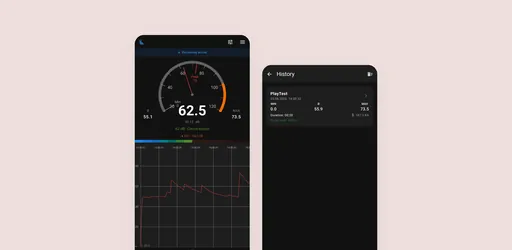
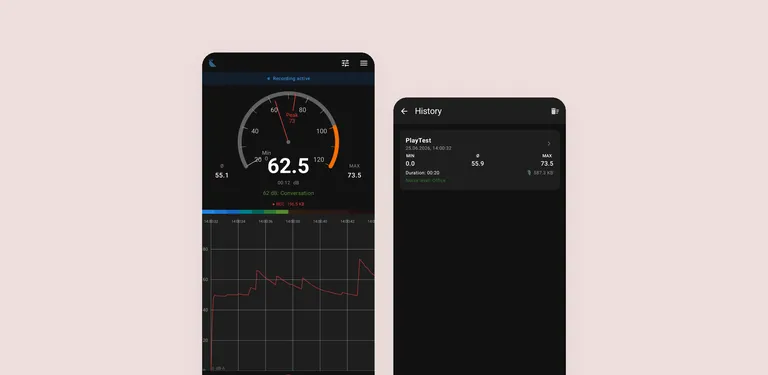
We built Sound Meter: Decibel dB Level for exactly these situations. It shows the current level in dB with a gauge and a level curve, plus minimum, average and maximum. You can save a measurement as an audio file and as a PDF report with a chart and peak values, keep measuring in the background while the screen is locked, and calibrate the app with an offset from −20 to +20 dB. The app is free with ads and optional in-app purchases.
Quick summary
- Whisper about 30 dB, conversation about 60 dB, heavy traffic inside a car about 85 dB, hair dryer about 100 dB, siren up close about 120 dB (WHO).
- Long or repeated exposure at or above 85 dBA can cause hearing loss (NIDCD).
- From 80 dB, the WHO's safe weekly listening time drops quickly: 40 hours at 80 dB, 4 hours at 90 dB, 20 minutes at 100 dB.
- Real sounds vary with distance, device and room, so measure when the exact value matters.